A new name, announced at the UN
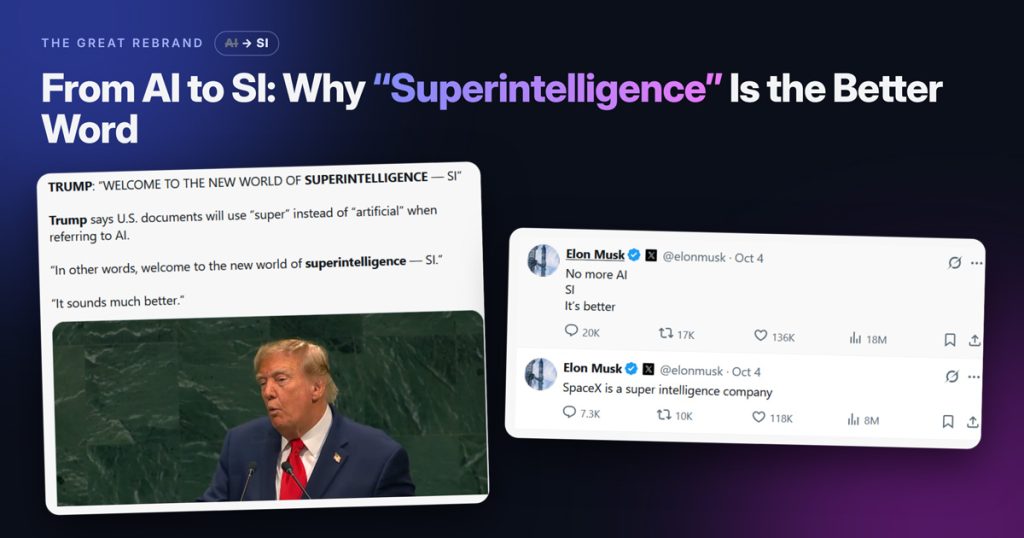
Donald Trump announced at the United Nations General Assembly on September 22, 2026, that the US would cease to use the term “artificial intelligence” (AI) and instead refer to the emerging technology as “Super Intelligence” (SI).
A week later, the President signed Executive Order 14434, under which all federal agencies would refer to AI as SI in all written and verbal communications, on all their websites and in all published documents. It would take several more weeks before the term AI was officially banned from all relevant government documents.
|
Date |
What happened |
|---|---|
|
Sep 22, 2026 |
Trump announces the switch from AI to SI at the UN General Assembly |
|
Sep 29, 2026 |
Executive Order 14434, Inaugurating the Era of Super Intelligence, is signed |
|
Late Oct 2026 |
Trump says the term AI will be banned from all relevant documents |
Why SI is the better word
Supporters of the change make four main arguments.
|
# |
Argument |
Why it matters |
|---|---|---|
|
1 |
“Artificial” is misleading |
Most people hear “fake” or “imitation.” Today’s frontier systems do far more than imitate isolated pieces of human intelligence. |
|
2 |
The old name no longer fits |
Current systems are far removed from the narrow human functions that inspired the term in the 1950s. A new name is needed to describe their growing reach. |
|
3 |
“AI” is a worn-out brand |
It has become the generic label for a flood of low-quality apps, scripts and widgets: celebrity chatbots, silly e-postcard sites, HTML5 scams and more. |
|
4 |
It frames SI as an opportunity |
Trump and Silicon Valley investors want SI seen as a major opportunity to cultivate, before negative public perceptions slam the brakes on. |
A slow transition
Government goes first. Federal agencies are the first to adopt SI. NIST, for example, has already started to implement the direction given by Executive Order 14434.
Tech leaders follow. Some of the biggest names in tech have started using the term, including Jensen Huang of Nvidia, Mark Zuckerberg of Meta, Satya Nadella of Microsoft, Arvind Krishna of IBM and Lip-Bu Tan of Intel. Huang now corrects himself and refers to the technology he demos as Super Intelligence, or SI (Axios).
Who is already saying SI
Some of the world’s largest and most influential tech companies have started to adopt “SI” in their public communications (Futurism, BigGo Finance).
|
Who |
Company |
How they use SI |
|---|---|---|
|
Elon Musk |
SpaceX, Tesla |
Uses SI consistently in posts and public appearances; rebranded SpaceXAI to SpaceXSI |
|
Jensen Huang |
Nvidia |
Says Super Intelligence in social posts and on panels; on rare slips into “AI,” he corrects himself |
|
Mark Zuckerberg |
Meta |
Calls for “personal superintelligence”; Meta Superintelligence Labs studies its implications |
|
Satya Nadella |
Microsoft |
Writes of the “Super Intelligence era” in his letter to shareholders |
|
Arvind Krishna |
IBM |
Used both AI and SI on IBM’s latest quarterly earnings call |
|
Lip-Bu Tan |
Intel |
Says superintelligence demand is driving the need for more chips amid shortages |
|
Nikesh Arora |
Palo Alto Networks |
Mentions SI in many of his TV interviews |
|
Sam Altman |
OpenAI |
Says “Super Intelligence” is more accurate, but won’t rename OpenAI to “OpenSI” |
The other side
Many critics worry the new name causes more problems than it solves:
- It borrows an existing term. “Superintelligence” has historically meant ASI (artificial superintelligence): systems significantly smarter than humans. No current frontier system is superintelligent, so critics say it should not share the name (Poynter, Nature).
- It may be more tribute than accuracy. Some see the switch as a gesture of political loyalty rather than a better description.
- It may not reach ordinary users. Many expect only CEOs and senior officials to use SI, not typical users. A YouGov poll found 53% still prefer “artificial intelligence,” against 9% for “super intelligence.”